
A complete Business Reliability System, deployed in your environment.
Provide a suitable Linux server. W3Patterns installs and configures the complete system—including BRS-Core—and delivers it live and working.
Everything you need to operate BRS-Core.
BRS-Server includes BRS-Core plus the monitoring, dashboards, alerting, and external checks around it. You don't receive a collection of tools to assemble. You receive a working system.
BRS-Core
Runs, schedules, and records the business verifications your organization depends on.
Prometheus
Collects BRS-Core results and the monitoring data used by the system.
Grafana
Turns those results into clear dashboards for business reliability.
Alertmanager
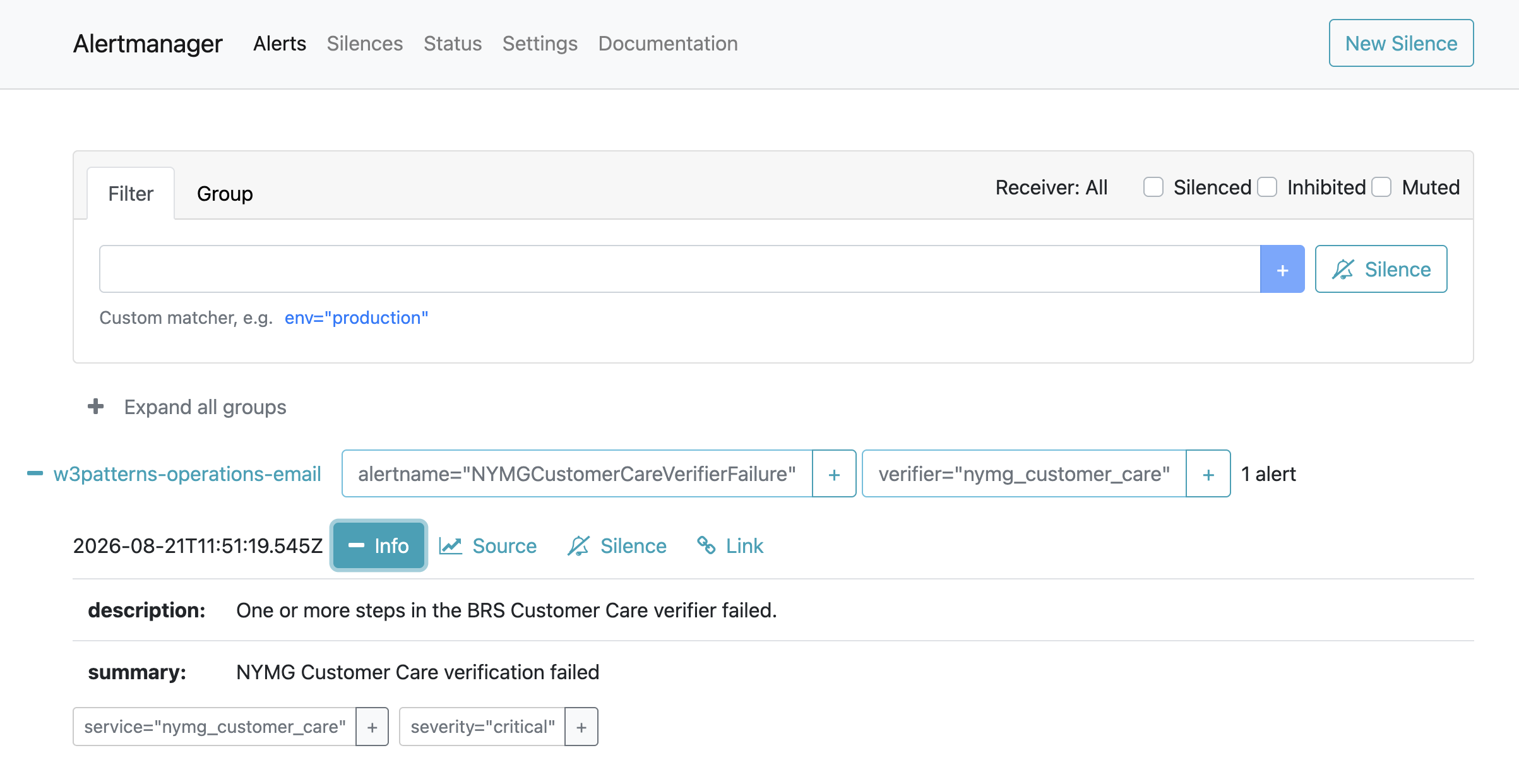
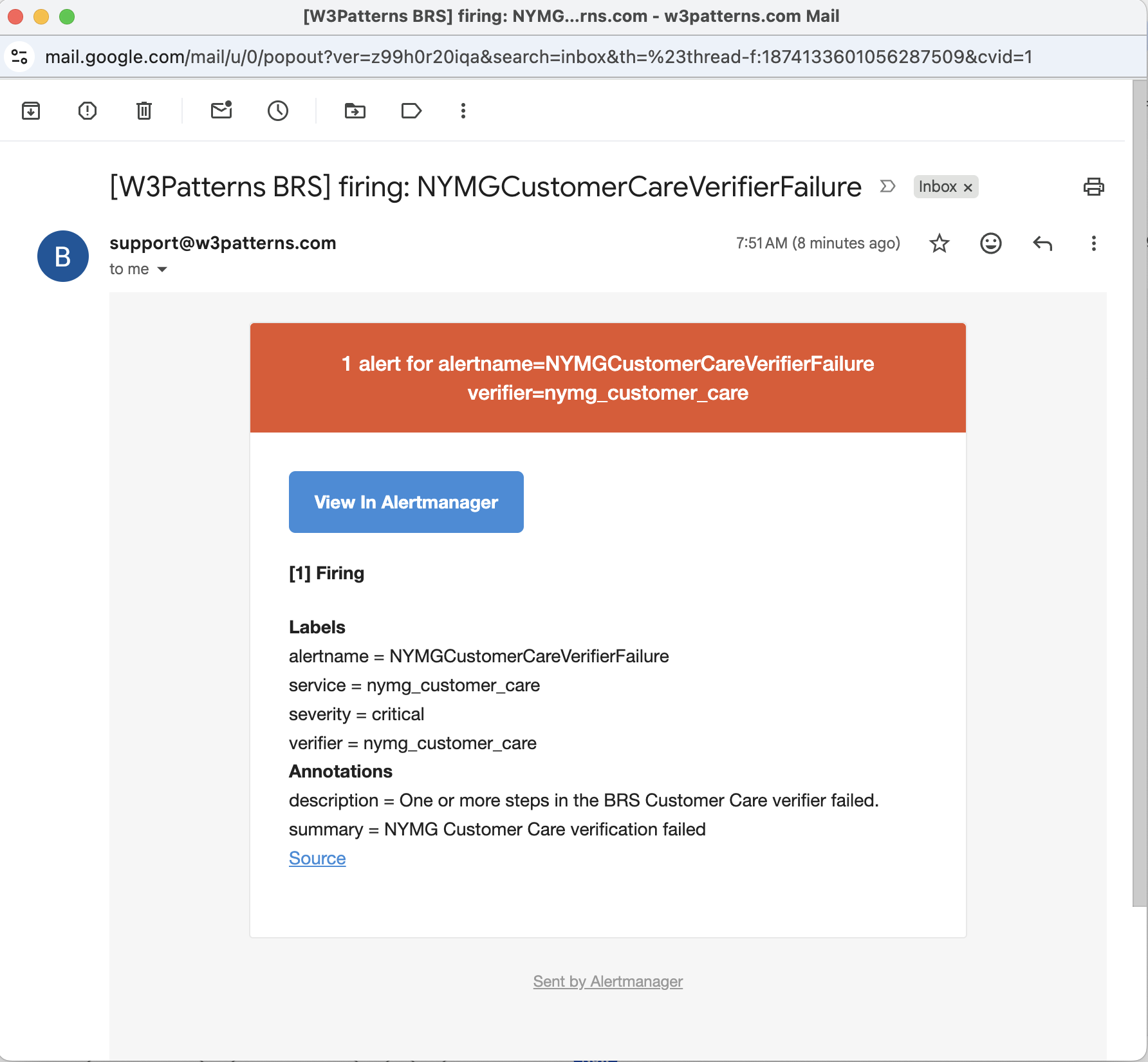
Routes alerts when a monitored capability or service fails.
Blackbox Exporter
Provides basic external checks for websites, APIs, DNS, certificates, and network endpoints.
Configured and connected
W3Patterns connects the components and verifies the system is live and working before delivery.
See a business capability being verified.
BRS-Core does not stop at checking whether a website or service responds. Verifiers can exercise the business capability itself and export the results as Prometheus metrics. In BRS-Server, those results are collected and visualized in Grafana alongside infrastructure health.
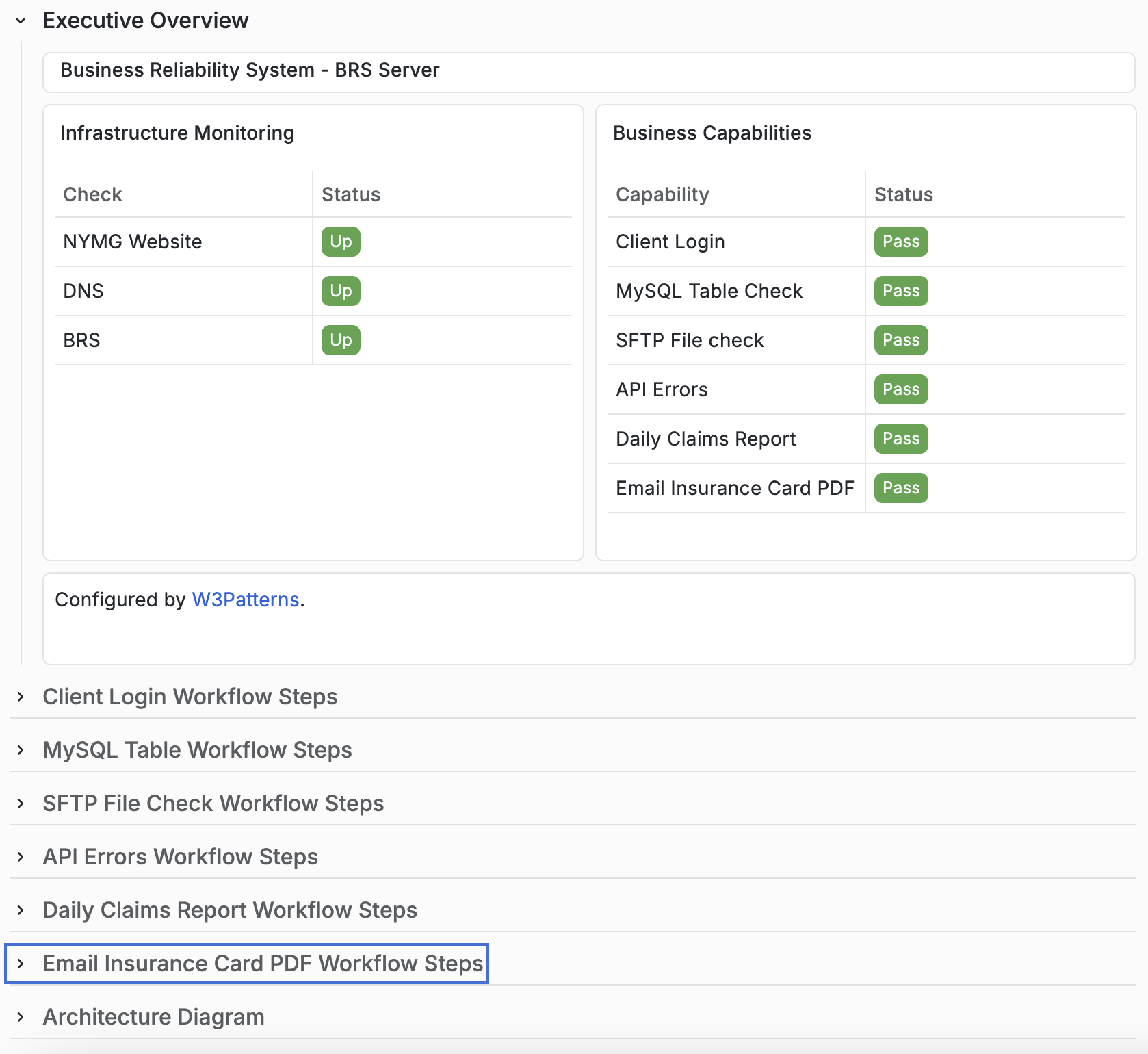
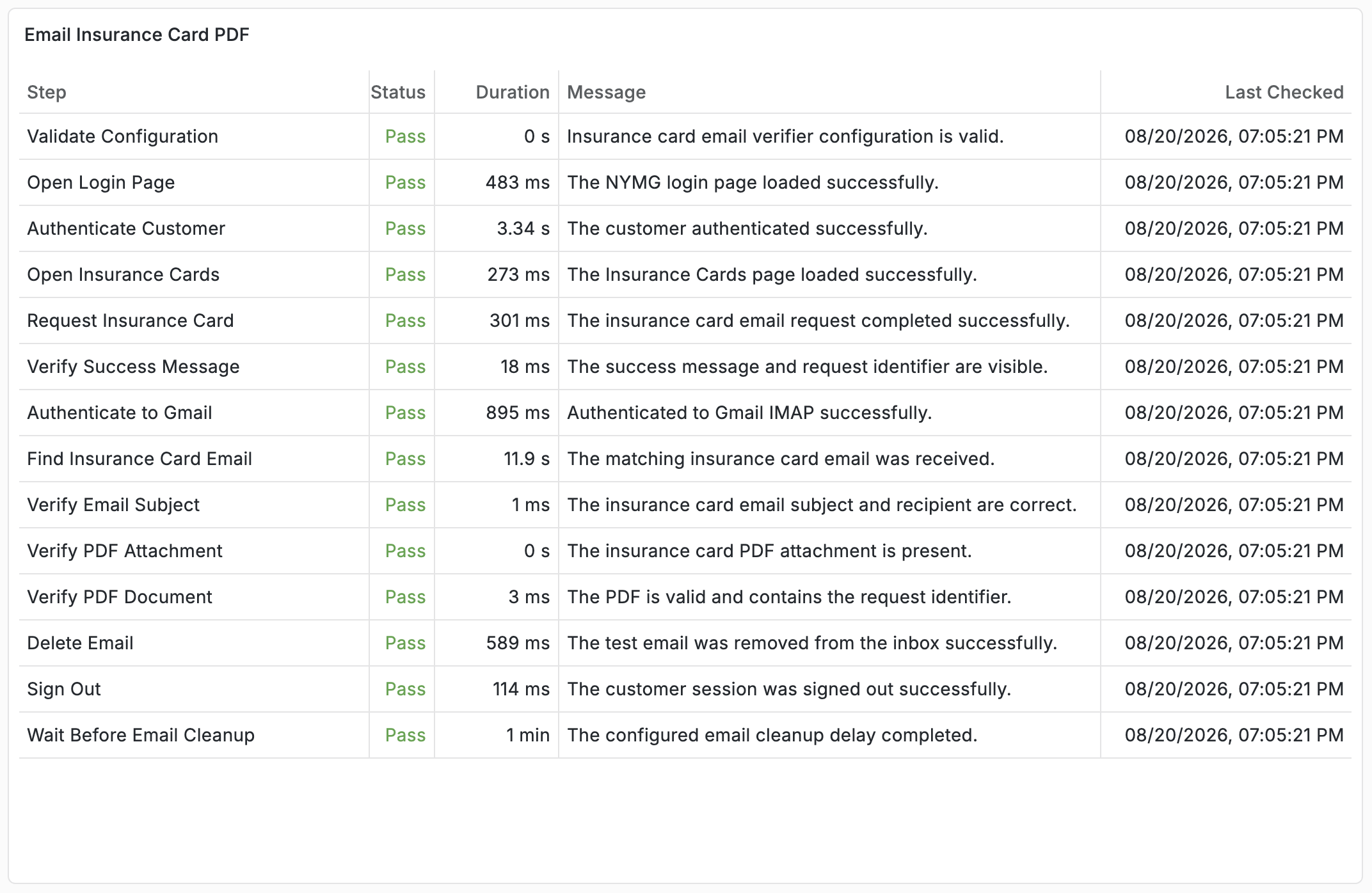
A “Pass” can represent an entire business outcome.
The Email Insurance Card PDF verifier exercises a complete customer workflow. It signs in, requests an insurance card, confirms the request, waits for the delivered email, validates the recipient and subject, verifies the PDF attachment and its contents, and cleans up afterward.
BRS-Core records the outcome, duration, and message for each verification step—not simply whether an endpoint returned HTTP 200.
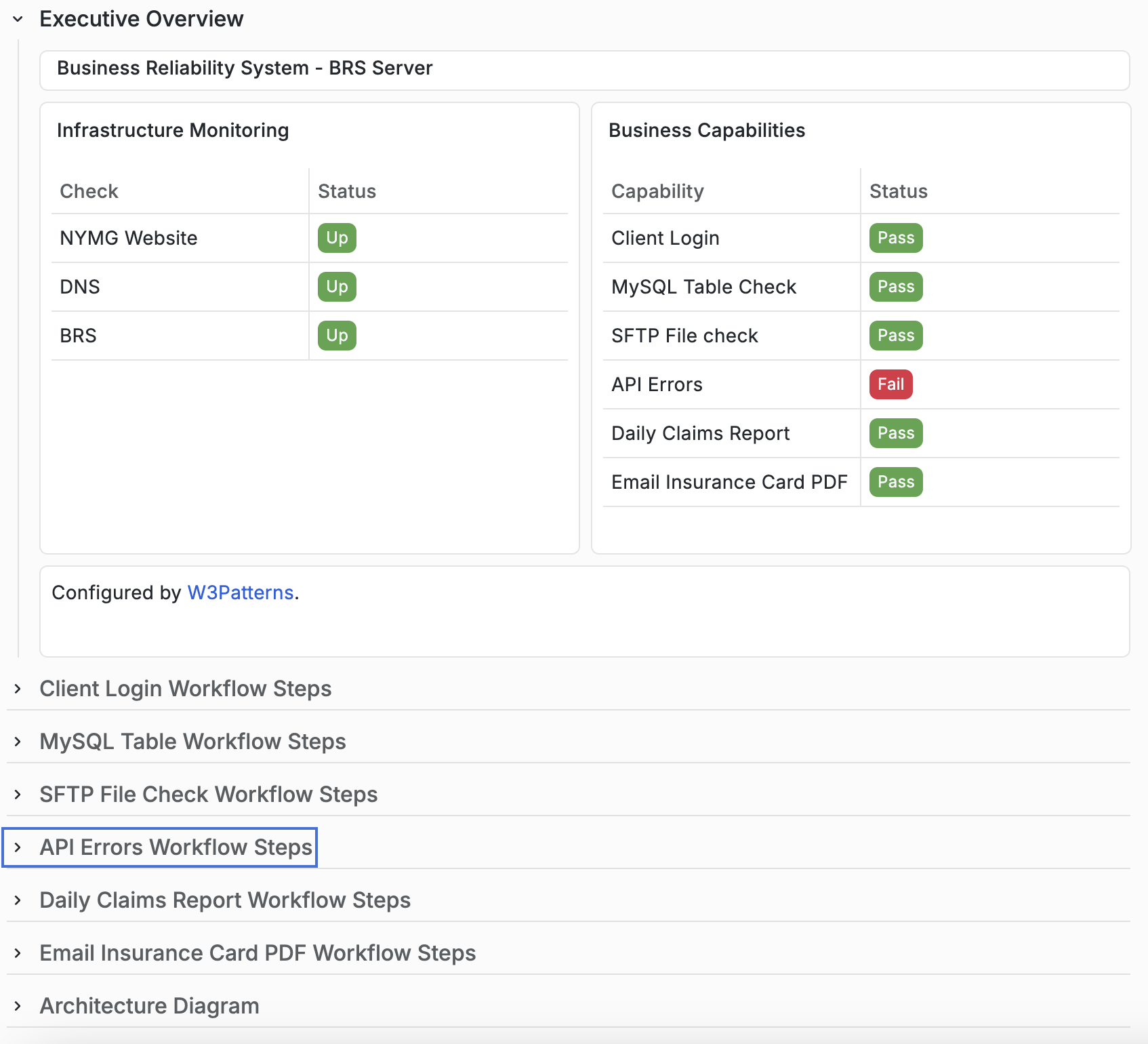
A “Fail” can reveal exactly where a business outcome broke.
A website can be up, DNS can be healthy, and customers can still sign in—while a critical business capability is failing. BRS makes that difference visible.
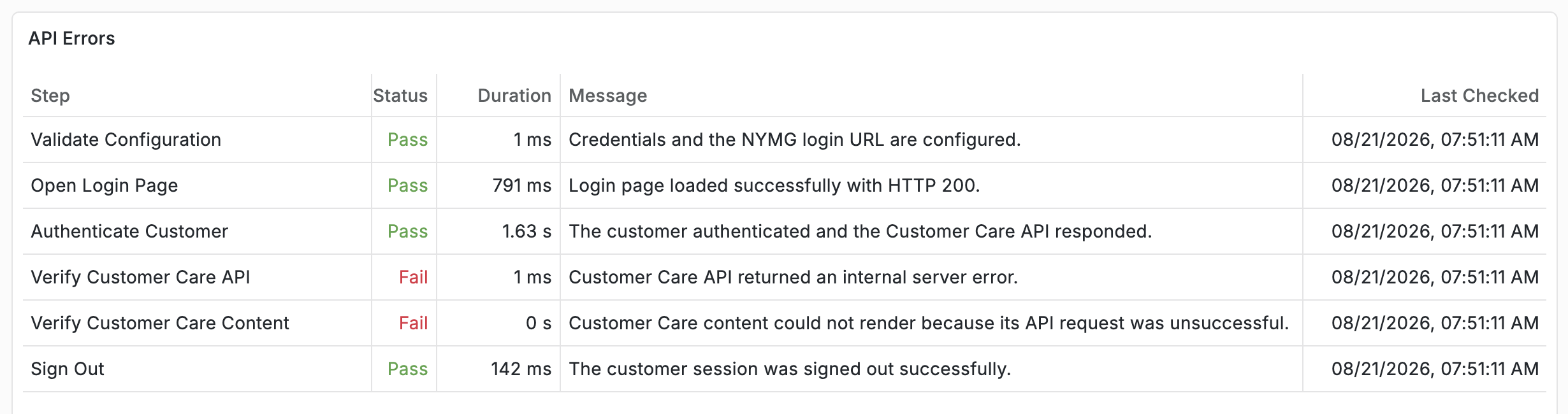
See where the expected outcome stopped being true.
The customer can reach the login page and authenticate successfully. The failure occurs later, when the Customer Care API returns an internal server error and the expected content cannot render.
Instead of a generic “site down” alarm, teams get evidence that narrows the problem to the failed business step. That means less time proving what still works and more time addressing what does not.
Because uptime is not the same as the ability to do business.
Customers do not care that the server is reachable if the capability they came to use is broken. A failed login, checkout, claims process, document delivery, data transfer, or customer-care workflow can interrupt revenue and service while infrastructure monitoring remains green.
BRS continuously verifies the outcomes the business depends on, shows where a failure occurred, and alerts the people who can act. That shortens the time between a business capability breaking and the organization knowing exactly what needs attention.
You provide the server. We provide the system.
You provide a suitable Linux server in the environment where BRS-Server will operate, administrative access during deployment, and the network access the system needs.
W3Patterns installs and configures BRS-Core, Prometheus, Grafana, Alertmanager, and Blackbox Exporter, connects the components, and confirms the system is working.
Deployed in days, not weeks.
Observe, don't invade.
BRS-Server is designed to observe your systems through approved interfaces. It does not require W3Patterns agents on your production servers or changes to your application code.
The server and the Business Reliability System remain in an environment your organization controls.
Your system. Your server. No meter running.
BRS-Server is deployed in your environment and belongs to you. W3Patterns does not need to remain involved for the system to keep running.
No monthly W3Patterns subscription
You don't pay W3Patterns every month simply to keep BRS-Server running.
No W3Patterns hosting fees
The system runs on the server your organization provides and controls.
No usage meter
No W3Patterns per-user, per-verifier, or per-check fees. W3Patterns does not impose usage limits on your system.
Start with a known-good working system.
BRS-Server is delivered with BRS-Core and its working examples connected to the surrounding monitoring system. That means the system is live before custom work begins.
The included examples provide a proven model for the business capabilities you may choose to verify next.
Already own BRS-Core?
Perfect. You already own the software foundation of BRS-Server.
You won't pay for BRS-Core again.
BRS-Server has a clear finish line.
- BRS-Core is installed and running
- Prometheus is collecting the results
- Grafana displays the system's status
- Alertmanager is configured for the standard deployment
- Blackbox checks are connected where applicable
- The complete system is live in your environment
Customize when you're ready.
BRS-Server is intentionally a defined deployment—not an open-ended consulting project.
Need custom verifiers, custom dashboards, additional integrations, or other observability work after deployment? The W3Patterns Fractional Observability Team is available at $100/hour.
Explore FOTFrom a Linux server to a working Business Reliability System.
BRS-Core, Prometheus, Grafana, Alertmanager, and Blackbox Exporter. Configured, connected, and running in your environment. Deployed in days, not weeks.